
Two major Cyberattacks in two Weeks Send a Warning Africa Cannot Ignore
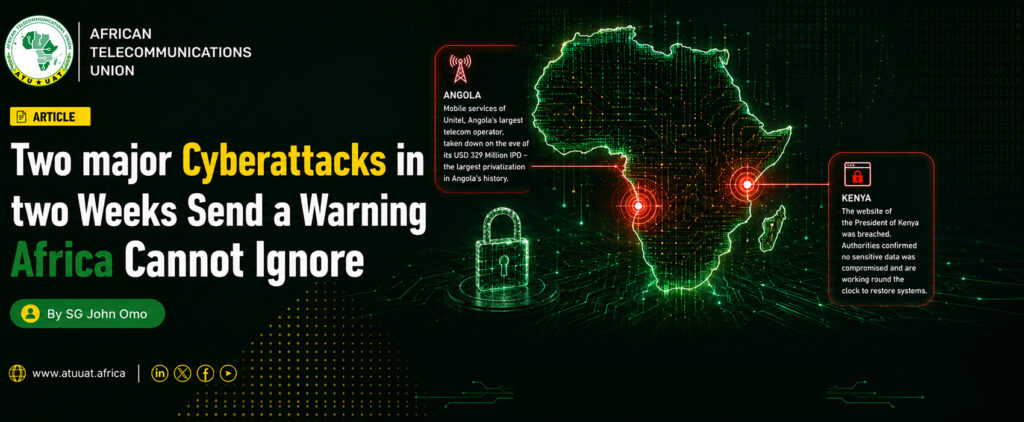
Two major cybersecurity incidents within the space of two weeks in July 2026 delivered a warning that African governments, companies and internet users cannot afford to ignore.
The first was the taking down of mobile services operated by Unitel, Angola’s largest telecommunications Company. The incident came on the eve of trading in the company’s shares on the Luanda Stock market. Unitel’s shares had been oversubscribed, raising a total of USD 329 Million through the initial public offering and making it the largest privatization project in Angola’s history.
Days before the Angola incident, the website of the President of Kenya was breached. Kenya’s Cabinet Secretary, Ministry of Information, Communication, and Digital Economy, Hon. William Kabogo assured the public there had been no breach of or loss of sensitive data and that authorities were working round the clock to restore systems.
What could have motivated these brazen attacks can, for now, only be the subject of conjecture as investigations and restoration efforts are ongoing. Their timing, however, is difficult to dismiss. Both targeted systems tied closely to public confidence and essential services.
Motives for cyberattacks differ from one case to the other, but are often linked to financial profit, such as stealing credit cards, demanding ransomware payouts, or selling data on the dark web. Others involve espionage and intelligence with state-sponsored groups or competitors stealing trade secrets or classified data.
Ideology and hacktivism can also drive attacks, with services disrupted or websites defaced to promote a political, social, or religious cause. In other cases, the intention is disruption and sabotage – crippling critical infrastructure such as telecommunications networks, power grids and hospitals.
Africa is experiencing escalating cyber security threats driven by rapid digital expansion. Current estimates indicate that the continent conservatively loses about USD 5 billion every year to cyberattacks and cybercrime. Organizations experience thousands of attacks weekly, outpacing institutional defences and infrastructure.
The major threats include ransomware and extortion targeting critical databases; online scams and phishing aimed at mobile financial services and everyday internet users; and, business email compromise – directed at corporate and government wire transfers. Artificial intelligence-driven exploits are adding another layer through bot campaigns, deepfakes and impersonation.
Africa’s vulnerability is made worse by acute cyber-defence gaps. Digital adoption, mobile money and cloud services have scaled much faster than cybersecurity budgets and skilled personnel. Under-secured interconnected ecosystems, decentralized infrastructure and smart devices have created wider attack perimeters.
There is therefore a compelling case for African governments and organisations to invest more in cyber-security. Public awareness campaigns should encourage strong passwords, multi-factor authentication, caution around unsolicited links and the need for regular software updates.
Governments and organizations must secure back-up data and strengthen networks through encryption and firewalls. Additionally, given the transboundary nature of cybercrime, national cyber security authorities need stronger continental and global cooperation, standardized approaches and reciprocal enforcement measures.
The incidents in Angola and Kenya may be resolved, but their warning should not be lost. Africa’s digital expansion is creating enormous opportunity, yet every new platform, connection and service create additional points of exposure. The continent’s progress will remain vulnerable unless investment in cybersecurity grows with it.