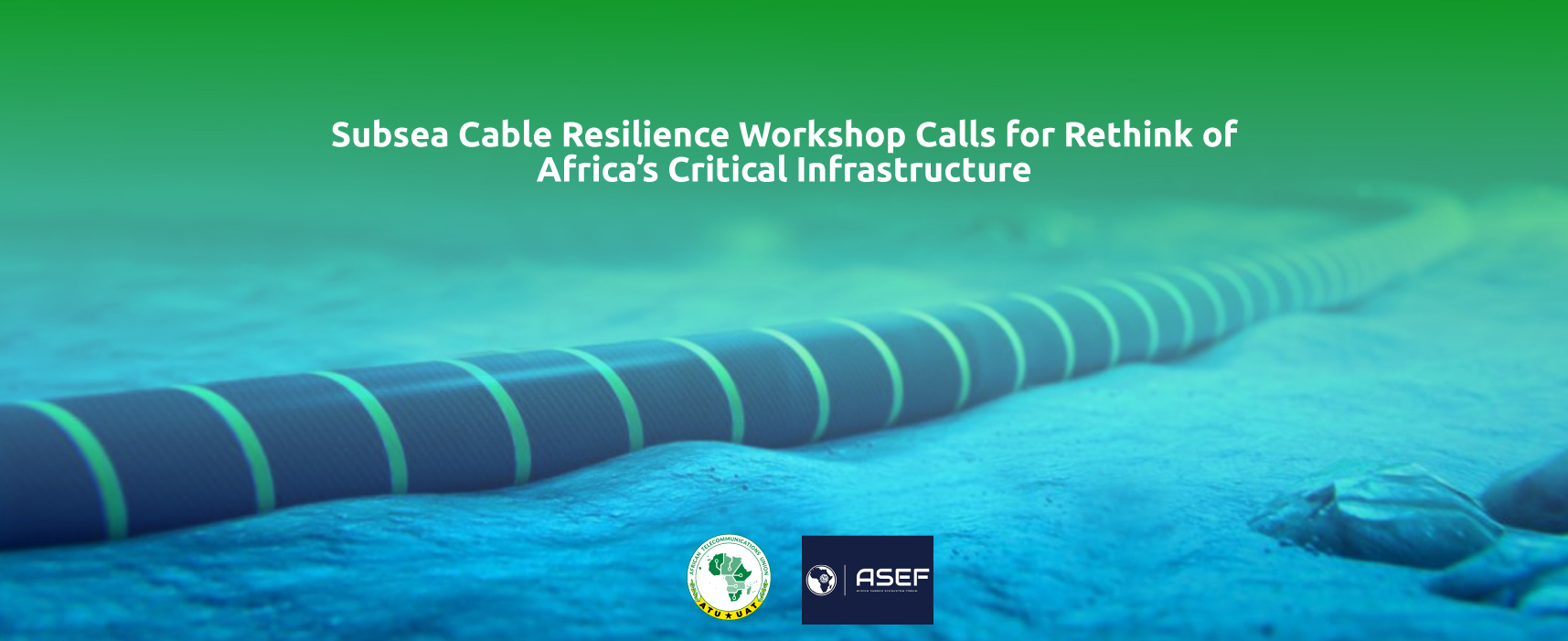
An online capacity building workshop on submarine cable resilience brought together 240 participants from 42 countries to examine Africa’s growing dependence on subsea cables whose fragility is increasingly a concern. Facilitators highlighted the risks posed by this vulnerability and called for stepped-up technical and regulatory measures to strengthen the continent’s connectivity.
Convened by the African Telecommunications Union (ATU) in partnership with the African Subsea Ecosystem Forum (ASEF), the workshop noted that submarine fibre cables now carry between 95% and 99% of international data traffic, underpinning internet connectivity, finance, education and almost every digital service on which modern economies rely.
“These cables are as strategic and critical as anything we build on land. They carry our economies, our public services and, increasingly, our social lives,” said ATU Secretary General John Omo, in his opening address.
The urgency of the debate has been sharpened by a series of high-profile outages. In March 2024, simultaneous cable cuts on Atlantic systems slowed or crippled services in more than a dozen countries leading to loses amounting to hundreds of millions of United States Dollars. Later incidents in East and Southern Africa reinforced how quickly a single break can cascade into economic disruption.
Yet capacity keeps growing as more than 500 telecommunication submarine cable systems are now active or planned worldwide, with 77 already in service or under construction on African shores and 37 African countries now hosting at least one cable landing.
Globally there are between 150 and 200 cable faults each year and a single repair can cost around 2 million US dollars. One of the workshop facilitators, Geraldine Le Meur of GreenLink Marine, noted that almost all of the faults that occur annually take place in waters shallower than 100 metres where human activity is most intense.
“About 98% of these incidents take place within states’ exclusive economic zones and are caused mainly by fishing gear, anchoring and dredging rather than sabotage; and damage remains overwhelmingly accidental,” she said, arguing that better planning, deeper burial and closer engagement with fishing communities can sharply reduce fault rates.
The workshop benchmarked other regions such as Asia Pacific, highlighting Singapore, where authorities already manage 26 active cables and expect that number to double in the coming decade, and where subsea systems are treated as critical national infrastructure with strict no anchoring and no fishing rules around landing corridors. Malaysia has reduced repair delays by lifting cabotage restrictions on cable repair vessels in March 2024, while Australia’s cable protection zones were cited as a model of long-term seabed governance that has helped keep fault numbers low.
Mark Tinka, co-founder of TransmissionCo and former SEACOM engineering head, described subsea investment as “a success story that is only half written”. While new systems such as 2Africa have transformed connectivity on the coasts, much work remains. 2Africa is a large subsea project that spans about 45,000 kilometres, connects 46 landing stations in 33 countries, and is currently the longest subsea cable in the world. However, weaknesses in backhaul mean that capacity often struggles to reach inland cities and frequent terrestrial fibre cuts interrupt services before they reach providers and users.
Several speakers warned that resilience at sea will mean little if the terrestrial stretch between landing stations and data centres remains fragile. Aqua2Terra co-founder Samia Bahsoun argued that designs for new terrestrial backbones need to borrow more directly from subsea practice, with equipment powered end to end and placed in sealed buried manholes instead of exposed roadside huts. She said such approaches would reduce dependence on intermediate amplifier sites that sit on unreliable grid power and are frequent targets for theft and vandalism
Samia’s intervention reinforced a wider view in the workshop that subsea grade thinking must extend onto land if Africa is to strengthen what many participants described as the weakest links in its networks.
General Manager of MEA Region from HMN Technologies, Mr. Chongguang Ma, presented an AI-enabled network management system that crunches alarms, performance data and test results from repeaters, branching units, power feeding equipment and optical interfaces. The system produces a continuous health score for cables and can predict “sub-health” status and likely failures with accuracy reportedly above 90%.
Speakers returned repeatedly to the fact that the average global delay for cable repairs is around one and a half months, largely because of permitting and cabotage rules rather than a shortage of ships. In many African states, entering territorial waters still requires complex multi-agency approvals.
Douglas Njenga, Director for Regulatory and Strategic Affairs, at the West Indian Ocean Cable Company who also serves in the Executive Committee of the International Cable Protection Committee (ICPC) noted that in one African country a single permit can take up to 48 weeks, while a similar process in Singapore is completed in about two weeks.
Kevin Mutuma Kaburu of SEACOM reminded participants that Africa accounts for about 0.02% of global fibre while hosting roughly 18% of the world’s population, a massive deficit that leaves many communities dependent on mobile broadband as the only realistic option. High-capacity terrestrial backbones remain concentrated in coastal and urban zones, and no African country ranks in the top 45 globally on fibre density.
ATU Secretary General John Omo cast the workshop as part of a broader shift from discovering Africa’s weaknesses during outages to designing resilience into networks from the start. He linked its outcomes to the work of the International Advisory Body for Submarine Cable Resilience, set up by the ITU and the International Cable Protection Committee in 2024, where Africa, through Nigeria’s Minister of Communications, Innovation and Digital Economy, Hon. Dr. ’Bosun Tijani, already holds a leading position as co-chair.
Building on the success of this workshop, ATU and ASEF have committed to planning more focused follow-up sessions to address the many different dimensions of the subject supporting education, partnering with regulators and industry players to strengthen the resilience of the Subsea ecosystem in Africa and protecting the digital lifelines.